Illustrations by Rama Duwaji
Close quarters and hidden corners, open secrets and exclusive invites: a dark room can be almost anything, anywhere, and can host all manner of intimacies. Five writers take us inside.
PANORAMA BAR
by Zack Graham
I was nervous that morning. My friend P and I had breakfast around 8 a.m. in our hotel, then headed to V & M’s flat in Kreuzberg to pregame.
I was no stranger to Berlin, having visited a dozen times before for work. I’d been to a handful of the clubs there, always late at night and alone. Sisyphos. Watergate. Ritter Butzke. Club culture in Berlin had emerged from the rebellious energy against the Soviet Union in the late 1980s, when, after the fall of the Berlin Wall in November 1989, Berliners won newfound freedoms and techno flourished across the city.
I’d never tried to get into Berghain. Though I wanted to go more than anything, I assumed, as a solo Black Jewish American with straight-dude energy, that I would be turned away at the door. I had no desire to wait in line for hours only to be rejected.
Things changed when I met V & M. They knew the people who worked there, and said they could get me in without a problem. All I had to do was let them know the next time I was in town, as I was that Fourth of July weekend.
I’d read everything about the history of this world-famous institution. I knew how it began as a party called Ostgut in a building where engineers used to repair trains on the banks of the Spree. Initially, there was only one very large, very dark room in which DJs played nothing but industrial techno. I knew that certain nights were themed around various kinks—puppy play, or watersports— and that some people would bring their own shit along in a plastic bag. I knew, also, that Ostgut closed in 2003, and that the organizers opened what is now known as Berghain in 2004 inside of an abandoned heating plant on the border between Kreuzberg (Berg) and Friedrichshain (Hain).
I knew that Berghain melded the queer sex-party ethos with world-class techno. Prior to Ostgut, the two were rather disparate. The “darkroom” spaces for sexual exploration had never been successfully fused with world-class sound engineering and brilliant musicianship before.
The place I was most excited to explore inside of Berghain wasn’t the main techno room, or the back garden, or even the ice cream parlor, but Panorama Bar. It was the light above the darkness, I’d been told. A brighter, warmer, more eclectic dance floor where DJs played house music and disco. There are famous steel-cupped bulbs suspended from the ceiling like metallic eyes, flashing like cameras from the 1920s. I’d heard that when the DJ plays the kind of song that breaks the crowd into a bliss that manifests in whoops and screeches and whistles, the industrial metallic shutters covering the floor-to-ceiling windows open, and sunlight blinds you, reminding you that there is a world outside of the room. This is the light engineer’s highest compliment to the DJ: a reminder that the sun exists at all.
We arrived at Berghain around 11 a.m. that Sunday. There was no line. The four of us were waived into the atrium. First, security. Then, tickets. It had been so easy. Something wasn’t right. Panic swelled in my chest. And then I steadied myself, took a deep breath, and walked in.
NEW YORK SEX CLUB
by Hallie Lieberman
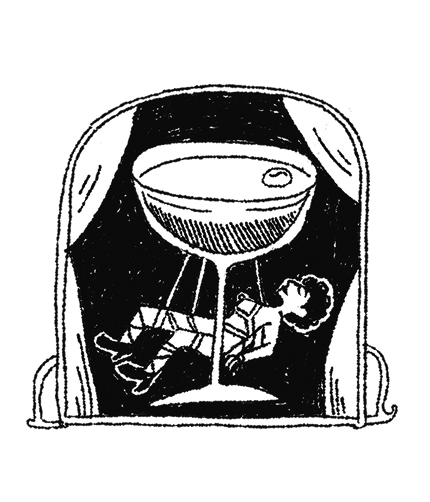
It was 1:15 a.m. on a chilly Saturday night, and the orgasms had just begun. Nearly two hundred partygoers were scattered throughout the penthouse suites of a posh hotel in the Lower East Side of Manhattan, laughing and flirting, sucking and fucking. To make it through the velvet ropes into this high-end orgy, they’d filled out an application, aced a Zoom interview, and taken STI tests, all to ensure they were attractive, charming, and healthy enough to fuck among the elites of New York’s sex scene. Most had paid $300 and a monthly fee of $40 or so to be there. Others were working the party in exchange for discount admission.
I had been invited by the party’s publicist and I didn’t know what to expect. I’d been to clubs before, but they were less upscale affairs: a rural Pennsylvania barn bacchanalia, a warehouse party in Berlin full of revelers frolicking in satyr costumes. Here, I was witnessing something different: the upper echelon of organized sexual hijinks, the Met Gala of fucking. Opulence reigned. I roamed the labyrinthine rooms the hosts had rented from the hotel months in advance. Days before, the party’s cocreators and volunteers had rearranged the hotel rooms’ furniture and made space for a spanking bench. They’d kitted out the rooms with red mood lighting, floor mattresses, condom and lube stations, and a table full of pre-rolled joints. The hotel had been hosting the events for years. The other guests staying on lower floors seemed unaware of the revelries occurring above. I walked past a smooth-chested man in a harness thrusting vigorously into a beautiful brunette as a group of ball-gowned women and tuxedo-clad men surveyed the scene while sipping on espresso martinis.
Moans of female pleasure ricocheted through the room as voyeurs popped melon balls into their mouths and consent guardians looked on, their light-up halos flickering atop their heads. I made my way to a hallway with a view of the shibari room, where ropes dangled from a rig and a bald white man with a gray beard was skillfully wrapping Japanese bondage ropes around the legs and torso of a twenty-something Black woman.
I watched, standing next to a striking woman clad in a teddy and stilettos, who told me the woman being tied up was her friend. The two were attending the party for the first time. Her friend had told her she wasn’t planning on doing anything sexual that night. We watched as the man spread her friend’s legs further. She began moaning. He pushed her underwear aside and started going down on her.
“Uh, I guess she changed her mind,” the friend said to me. She averted her eyes and gazed out the large glass window toward the Empire State Building. “It’s kind of awkward watching her,” she explained. “I want to give her privacy.” She peeked at her friend. She couldn’t help herself. “She seems like she’s having fun,” she said, sounding ambivalent. “I’m going to keep my eye on her to make sure she’s safe.” It was a weird thing to say while her friend was having public sex. But I understood: The strangers watching were random oglers, whereas she was witnessing a sexual awakening.

SOUTH END GREEN
by Jack Parlett
Head downstairs into the gents at South End Green, a small interchange just south of Hampstead Heath, and you will find a room more ornate than your average public toilet. Tiled from wall to ceiling in white and green, the room has a row of sixteen Royal Doulton urinals, topped by gray marble dividers. Facing them is a row of cubicles with wooden doors, and a locked attendant’s office. Two grates in the ceiling flood the room with daylight, but also expose its tattered areas, the chipped plaster, and cracked tiles. Built in 1897 and refurbished in 1999, with most of the original features left intact, South End Green is one of the last remaining Victorian public toilets in London, and one of only a dozen toilets in the city that is Grade II listed.
The room’s other claim to fame (or notoriety) is strongly hinted at by Camden Council’s “NO LOITERING” sign, an interdiction that rarely needs spelling out in this way. The latrinalia on the inside of the cubicle doors is more explicit: doodled cocks, phone numbers, and personal details, like those of one man (51) whose offer of a “Bum to Fuck” is scribbled prolifically across several panels.
I find these inscriptions oddly moving. One of the pleasures of public-toilet cruising today, in the age of Grindr, is this decidedly analog feel, the sense of historicity. Entering this atmosphere of faded quotidian grandeur, you hope to encounter a like-minded stranger. But also, perhaps, the traces of figures who cruised here before you, some of them quite well known. The playwright Joe Orton, who drank at the pub on the corner of South End Green (then called the White Horse), was said to cruise these gents often in the 1960s. In the final year of his life (before his murder by partner Kenneth Halliwell in 1967), Orton kept a diary in which he recorded how spaces like “the little pissoir under the bridge” (at nearby Holloway Road) could “become the scene of a frenzied homosexual saturnalia,” while “two feet away the citizens of Holloway moved about their ordinary business.”
Decades later, George Michael, pop culture’s most famous cruiser, was arrested and cautioned by police for possession of weed and crack cocaine at South End Green. During an afternoon cruising the Heath, he had been hanging around this toilet, tantamount to loitering in the eyes of the attendant, who likely tipped off the police. This was in 2008, ten years after his infamous bust by an undercover cop in a Beverly Hills bathroom, which outed him and forever altered his public profile. After his London run-in, he made a statement apologizing to his fans and vowing to get clean. But about public sex he was never apologetic, and proudly declared himself “a dirty, filthy fucker.”
As a contemporary space, this functional yet infamous room might seem retro in the wrong way, harking back to a time when sexual subcultures were forced underground, into dirty cubicles. To me it represents the sexual fearlessness that characterizes so much of queer history. “All the great public toilets of the world, the pissoirs of Paris, scenes of fabulous sex across the centuries,” the artist and writer John Giorno once wrote, in an essay about having sex with a young Keith Haring in a New York subway toilet, are “now lost.” South End Green is one of the greats, in this regard, but I suspect its days are numbered. The company that manages it, outsourced by the council, keeps the toilet open during office hours, but never in the evenings, even during the summer, the Heath’s busiest time. The insidious privatization of our cities jeopardizes more than just public convenience. “The loss of ecstasy in unlikely ordinary space,” Giorno wrote, “seems a great loss for everyone.”
PARADISE THEATRE
by Anna Fitzpatrick
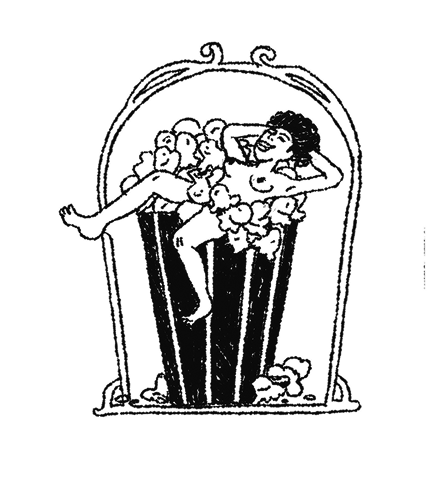
It was a bit of a challenge to determine who was in costume last Halloween at Toronto’s Paradise Theatre. The interior of the refurbished art-house theater, with freshly upholstered seats and luxe bathrooms, presents itself as one of the newer “upscale” theaters: There are no fountain drinks or popcorn, but you can get a glass of wine.
When private lender Moray Tawse bought the Paradise Theatre in Toronto’s West End in 2019, he had architects reconstruct the building’s art deco facade based on old photos. The venue has lived many lives since it opened as a movie house in 1937, including as a repertory theater, an Italian filmhouse, and, for the fourteen years before Tawse bought it, an empty building.
But tonight the venue is dressed up for the occasion with kitschy decorations. A preshow montage of retro Halloween cartoons and clips from campy forgotten musicals plays as a DJ onstage blasts “Von Dutch” to a packed room of queers. Miss Felatio, the light-up chandelier, and the Skims Merkin are all in costume; the crew in fetish gear and leather harnesses may just be having a fun Saturday night; the woman in lingerie and a giant bunny head will provide the intermission entertainment. She puts on a gory burlesque performance and it is wonderful, though I do worry about how hard it will be to clean fake blood out of the synthetic white fur. I am a nun.
We have gathered to watch Thundercrack!, Curt McDowell’s 1975 three-hour porn epic, described as “Rocky Horror Picture Show meets Deep Throat.” The film is playing as part of Sleaze Factory, a monthly series of on-screen erotica hosted by curator and drag artist Weird Alice. Aside from retro porn, the series has also screened the most recent release from queercore Canadian legend Bruce LaBruce, as well as more mainstream fare including Cruising and Basic Instinct.
Sluts and cinephiles have long shared an affinity for the possibilities of pleasure and transgression that a dark room provides. In one of its previous iterations, the Paradise was bought by a chain of adult theaters and from 1986 to 1990 was known as Eve’s Paradise. This tribute to the past was rooted firmly in the present. I never got a chance to visit Eve’s Paradise, being an infant when it closed, but I imagine it was a different experience than the community event I attended. What role does big-screen porno play in an era where we all have little computers in our pockets that expose us to fetishes our grandmothers could only dream of?
The porno-theater-as-site-of-anonmous hook- up, as described in Samuel R. Delany’s Times Square Red, Times Square Blue, will likely never make a comeback for many reasons, not least of which is that those same little computers we keep in our pockets are also recording devices. Cities are sites of constant evolution. At its worst, this can look like all the fun things have been forced out through price hikes or police crackdowns. At its best, it can be about finding new excuses to watch old dirty movies with friends and strangers. This was certainly my experience. Modern audiences have a tendency to laugh at the dated aspects of old movies, often to the chagrin of serious movie lovers, but it felt appropriate to laugh when Mrs. Hammond, the eccentric housewife, made a point of adding cucumbers to her grocery list. Later, when the cucumber was put to good use, there was applause. Seeing an old movie is time travel; old porn even more. We were entertained, and we were horny, and we can only imagine that so were the audiences watching this same movie fifty years ago.

STAR GARDEN
by Alexis Okeowo
For years, Star Garden Topless Bar advertised itself as the only topless dive bar in Los Angeles: a place in North Hollywood for lap dances, cold beer, and a game of pool. It was free to enter and then stay for the day or evening. There was a happy hour, and singles and couples were welcome. The place was tiny, what one dancer called a “mom and pop” club, in a terracotta-red split-level building that evokes a saloon, with wrought-iron double doors. Its staff and clientele felt like friends; it wasn’t corporate or cold, which made it a rarity in the Southern California stripping scene.
In May 2023, Star Garden became the only unionized strip club in the United States. Its dancers had voted to join Actors’ Equity Association at a heady moment for workers in the United States: Workplaces long considered impossible to organize, like Amazon and Starbucks, had successfully unionized in certain locations, and in LA, both the Writers Guild of America and the Screen Actors Guild had gone on industry-defining strikes. California has an uneasy relationship to its entertainment-industry unions. The state’s economy is dependent on its performers and the crews and businesses that operate around them, but those workers often have to fight for fair contracts.
None of the dancers at Star Garden had expected to be in the position of demanding a union. Reagan was studying acting when she started working there in 2011. “I found it to be very cinematic. I felt like I was in a David Lynch movie,” she said of the first time she visited one afternoon, the air hazy from a smoke machine. Scarlett, who identifies as nonbinary (and uses all pronouns), started dancing at Star Garden in 2017. She often lingered with customers to have a beer or play pool. “Think Cheers with titties,” she said. “I used to go to work so excited.” She would sometimes see a dancer in her sixties with big fake boobs on stage, or a girl who would get up on the pole and read a book as her performance.
As the years passed, and management changed, the club became dangerous. Star Garden had racist hiring policies. The bar was overserving customers and failing to control them. Reagan had one customer who exhibited stalking, obsessive behavior towards her; another recorded a dancer topless on stage without her permission; and yet another customer assaulted two dancers without consequence. When dancers told management that they weren’t safe at Star Garden, they were fired. “We realized it was up to us to take care of us,” remembers Reagan.
After serving management with a list of their demands, the dancers were locked out of the club. They protested for several months, sometimes dancing on a pole on the picket line. After fifteen months and the strippers’ unanimous vote to unionize, the club finally agreed to recognize an interim contract. “Typically, the public tends to think of exotic dancers as unintelligent,” Scarlett said. “And it was an opportunity for us to show that we are capable of working the system.” But when Star Garden reopened in August 2023, the club was unrecognizable. The music was too loud and the drinks too expensive. The club increased house fees and lap dance commissions, went cashless, and removed its ATM, which affected tips.
The dancers didn’t give up without a fight. They organized a one-day strike on the sidewalk, and brought out supporters and the press. But their case stalled at the National Labor Relations Board, and the endless waiting was agonizing. Their lawyer advised the dancers to go on an indefinite strike in spring 2024, and Star Garden responded by closing. They were still waiting for the NLRB to schedule a hearing to determine that the settlement agreement was violated, when President Donald Trump effectively gutted the agency.
“We really loved that club, and that’s one of the most heartbreaking things . . . I try not to let the disappointment take over and dim the really wonderful things that we were able to accomplish,” Reagan said. Talking to veterans in the labor movement helped her take a longer view. “We did do something historic, and we did move the needle for sex workers and strippers,” she said. “Maybe this generation will not really benefit from that, but maybe the next will. It’s hard to be satisfied with that, but it’s not nothing.”